

Ultrasonic Testing
Ultrasonic Testing (UT) is an advanced non-destructive testing method used to detect internal and surface defects in a wide range of materials. This technique uses high-frequency sound waves to evaluate material thickness, structural integrity, and hidden discontinuities such as cracks, voids, and inclusions. Ultrasonic Testing is widely used in industrial applications where accuracy, reliability, and detailed internal inspection are critical.
We provide precise and dependable Ultrasonic Testing services to ensure structural integrity, safety, and compliance with industry quality standards.
Our Ultrasonic Testing process involves transmitting high-frequency ultrasonic waves into the component using a specialized probe. When these sound waves encounter internal defects or material boundaries, they are reflected back and recorded for analysis. This allows accurate detection and sizing of internal flaws without damaging the component. UT is highly sensitive, versatile, and suitable for thick sections, making it an essential inspection method for critical industrial components.
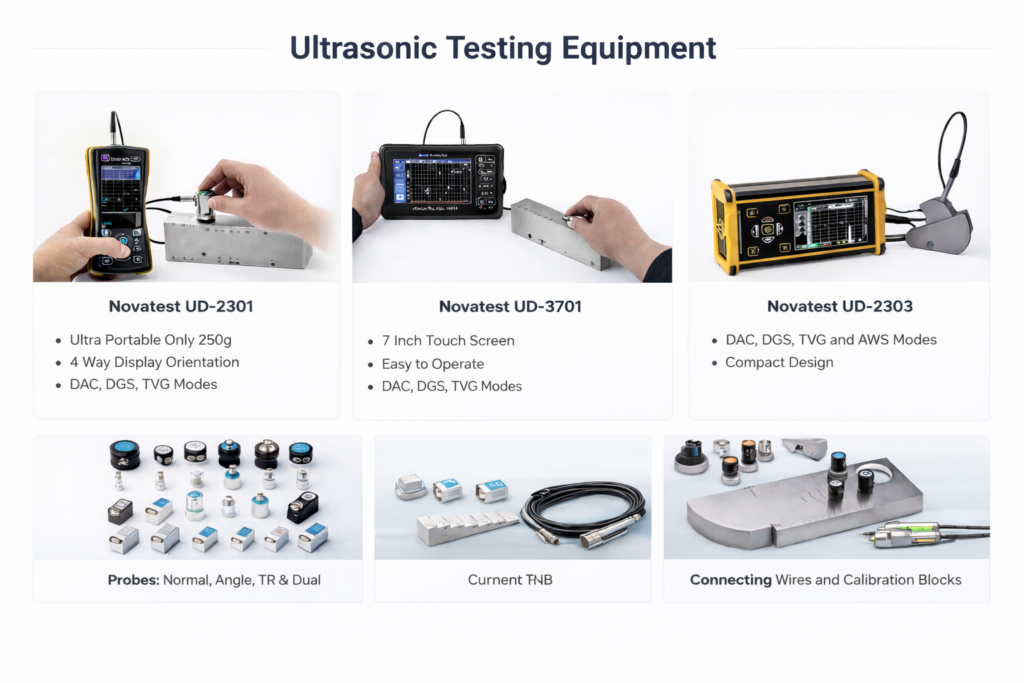
Click Here to Get More Information About the Above Products

Our benefits
- Detects internal and surface defects with high accuracy
- Non-destructive testing with immediate results
- Suitable for thick and critical components
- Provides precise defect location and sizing
- Enhances safety and material reliability
Ultrasonic Testing can be used on a wide variety of materials including carbon steel, alloy steel, stainless steel, aluminium, copper, castings, and composites. It is commonly applied to welds, plates, pipes, forgings, pressure vessels, and structural components where internal defect detection and thickness measurement are required.
Ultrasonic Testing is effective in detecting internal defects such as cracks, voids, laminations, inclusions, lack of fusion, and lack of penetration in welded joints. It can also be used for thickness measurement and corrosion monitoring in service-exposed components.
Ultrasonic Testing plays a vital role in preventing structural failures by identifying internal defects that cannot be detected by surface inspection methods. It improves quality control, extends component life, reduces downtime, and ensures compliance with safety and regulatory requirements across industries.